
Whole Body Communication: Behavior as Communication
As parents and caregivers, it is essential to shift our parenting perspective and examine our beliefs around behaviors and communication. This is especially important when we talk about our children with Pathological Demand Avoidance (PDA) and behavior. Many of us inherit our beliefs about children and behavior from our upbringing, school, or society as a whole. Without deeply examining these beliefs, we cannot truly support our children and meet them where they are in their development.
We need to uncover how we communicate with our children, not just verbally, but through our body language as well. Additionally, we must understand the importance of examining outward behaviors as a guide to what is happening neurophysiologically in our children. This includes understanding the two types of behaviors: Top-Down and Bottom-Up. It also involves shedding the deep-seated belief that children choose their behavior to manipulate parents to get what they want. This toxic belief erodes our children’s trust and confidence and damages our connection with them.
Come alongside me on this journey of understanding and unraveling the complexities behind behavior. Together, let’s explore our beliefs and make profound shifts in our perspectives, all while fostering strong and positive relationships with our children.
Whole Body Communication
Focusing on Body lanuage
Research indicates that a significant portion of our communication with others is non-verbal. While percentages vary among studies, there is consensus that non-verbal communication has the greatest impact on our interactions. It is crucial to bear in mind, especially when communicating with all children, but particularly with those who have PDA or sensitive nervous systems.
Understanding Dr. Stephen Porges’ work on the Polyvagal Theory reveals that our nervous systems communicate with each other through the social engagement system. With this understanding, we must recognize that neuroception continuously scans others and our environment for signals of safety. This highlights the importance of focusing on our body language.
When focusing on children with Pathological Demand Avoidance and behaviors, we have to remember they have an overactive threat response. Any modifications we can make with our body language can greatly impact our child’s feeling of safety and, in turn, their actions and behaviors.
Explore More on the Blog
No posts
No posts
Communicating Through Behavior
What Our Children’s Actions Say About Their Feeling of Safety Inside
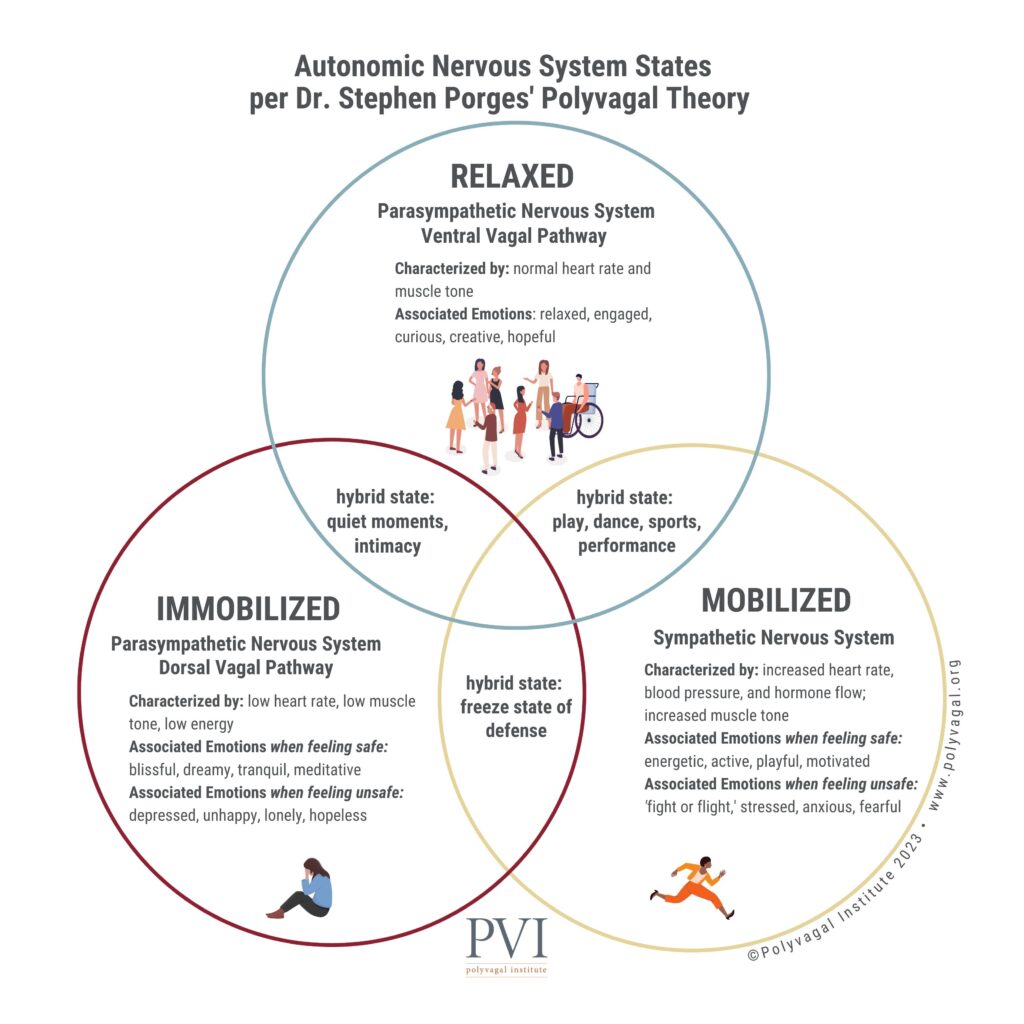
As parents, we often find our children’s behaviors incredibly confusing. However, with a deeper understanding of the nervous system and Pathological Demand Avoidance and behaviors, you create space for a shift in parenting paradigms. Therefore, viewing these behaviors as messages from their bodies, indicating the state of their nervous system, we can move away from feeling pressured to punish them. Instead, we recognize their actions as calls for help from their bodies. Consequently, we can focus on co-regulation and utilize felt safety to guide them back to a better place. Use the chart below to help you better understand what you are seeing from your child.
What Could It Mean?
Using Dr. Stephen Porges’ Hierarchy of the Autonomic Nervous System (ANS) per Polyvagal Theory to better understand your child’s behaviors.
Letting Go…
Dealing with Uninformed Opinions
references:
Delahooke, M. (2019, August 11). Top-down and bottom-up behaviors: Understanding the critical difference. Mona Delahooke. https://monadelahooke.com/top-down-and-bottom-up-behaviors-understanding-the-critical-difference/#:~:text=They%20are%20called%20bottom%2Dup,prefrontal%20cortex%20of%20the%20brain.
Johns Hopkins Medicine. (2023, August 1). Understanding the Teen Brain. Retrieved from https://johnshopkinshealthcare.staywellsolutionsonline.com/Wellness/Fitness/1,3051
Polyvagal Institute.” (2024, May 13). What Is The Polyvagal Theory. Retrieved from https://www.polyvagalinstitute.org/whatispolyvagaltheory
Porges, Stephen. (2004). “Neuroception: A Subconscious System for Detecting Threats and Safety” ZERO to THREE 2-4, no. 5